The Invisible Hand: How America's Most Discerning Homeowners Are Perfecting Properties Without Touching Their Soul
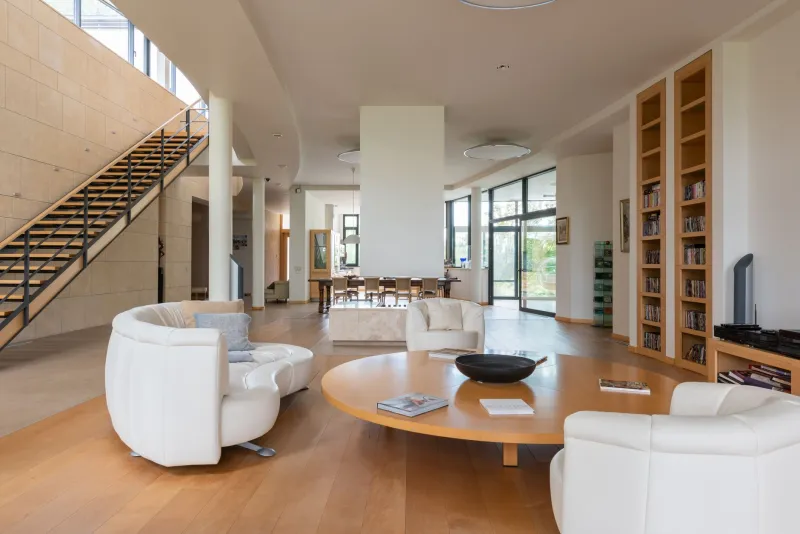
There is a particular kind of mastery that announces itself through silence. In architecture and interior design, the most commanding statement a wealthy homeowner can now make is not a dramatic addition or a conspicuous overhaul—it is a transformation so seamlessly executed that guests move through a space without ever suspecting that anything has changed. Yet everything has.
This is the logic of the stealth upgrade, a discipline that has quietly become the dominant renovation philosophy among America's ultra-affluent property owners. Where earlier generations of high-net-worth buyers once signaled investment through visible grandeur—soaring additions, imported marble, expansive new wings—today's most discerning owners are directing their resources inward, downward, and entirely out of sight.
The Philosophy of Functional Invisibility
The shift is not merely aesthetic preference. It reflects a deeper understanding of what genuine luxury means at the highest levels of the market: not the imposition of wealth upon a property, but the quiet elevation of a property to its fullest potential.
For many owners of historic estates—particularly those in established enclaves such as Greenwich, Connecticut, Montecito, California, or the storied residential corridors of Palm Beach—the architectural character of a home is inseparable from its value. A Georgian Revival built in the 1920s carries within its proportions and patina a kind of irreplaceable authority. To alter its exterior profile or disrupt its interior volumes in pursuit of modern convenience would be to diminish the very qualities that justified the acquisition.
The stealth upgrade resolves this tension by treating the home's existing form as inviolable. The work happens beneath plaster, above ceiling vaults, within the cavities of original millwork, and deep below landscaped grounds. When it is finished, nothing looks different. Everything feels different.
Climate as Craft
Few systems reveal the sophistication of this approach more clearly than climate control. In the conventional renovation, HVAC improvements mean visible ductwork, intrusive vents, or the installation of mechanical equipment that competes with architectural detail. In the stealth renovation, they mean something else entirely.
Radiant heating systems, for instance, can be threaded beneath restored original flooring—whether antique oak, reclaimed limestone, or hand-laid terra cotta—without disturbing a single board or tile above. Geothermal exchange systems, which draw heating and cooling energy from the stable temperatures found deep in the earth, are installed entirely underground, leaving the home's mechanical footprint invisible and its energy consumption dramatically reduced.
For properties with significant historic fabric, specialized contractors now offer what amounts to surgical intervention: routing minimal-profile air distribution systems through walls and ceiling cavities using flexible conduit sized precisely to the available space, then finishing the termination points with custom-fabricated grilles that replicate period hardware. A house that was built in 1912 can maintain a perfectly consistent 70 degrees without a single anachronistic register in sight.
Security That Disappears
The evolution of residential security at the ultra-luxury level follows a parallel trajectory. A decade ago, the presence of visible surveillance infrastructure—cameras mounted on corners, sensor housings affixed to door frames, intercom panels interrupting carefully considered wall surfaces—was accepted as a necessary compromise. Today, it is considered an aesthetic failure.
The most advanced security integrators working in the high-end residential market now treat concealment as a primary design requirement rather than an afterthought. Camera systems are engineered into architectural elements: embedded within custom-fabricated exterior lighting fixtures, integrated into the masonry of gatehouse columns, or installed behind purpose-built apertures in historic facades that are indistinguishable from original construction details.
Beyond cameras, perimeter detection has migrated entirely underground. Buried sensor arrays can identify the pressure signature of a footstep or the vibration profile of a vehicle at distances of several hundred feet, transmitting alerts to a monitoring system without a single above-ground component. The landscape looks as it always has. Its awareness is total.
Access control has undergone a similar refinement. Biometric readers are now available in formats that integrate seamlessly into period door hardware, appearing to the uninformed eye as nothing more than an unusually elegant lockset. The technology is present. Its presence is not.
Structural and Mechanical Foundations
Beyond climate and security, the stealth upgrade extends to the fundamental infrastructure of a home's long-term performance. Electrical systems in older estates are frequently updated to support the demands of modern technology without altering a single visible outlet plate or switch cover. Plumbing upgrades, including the replacement of aging supply lines and the installation of whole-house water filtration, are accomplished through access panels concealed behind original cabinetry or within the mechanical spaces of subterranean utility rooms.
Foundation reinforcement—a necessity for many historic properties that were never engineered for the weight of contemporary additions or the demands of modern mechanical systems—is accomplished through minimally invasive techniques that require no excavation of finished interior spaces. Structural engineers working at this level have developed methods for introducing carbon fiber reinforcement, steel micro-piles, and epoxy injection systems through access points so small that they can be concealed beneath a single floor tile or a removable section of baseboard.
The result, in each case, is a property that performs like a new construction while reading as a historic one—a distinction that carries significant weight in the appraisal and resale markets.
The Market Logic of Restraint
Beyond philosophy and aesthetics, the stealth upgrade reflects sound financial reasoning. Properties that have undergone conspicuous renovations—particularly those that imposed contemporary design sensibilities onto architecturally significant homes—frequently encounter resistance in the resale market. Buyers who are drawn to a historic estate are drawn, in part, to its authenticity. Evidence of heavy-handed modernization can undermine that authenticity, and with it, a meaningful portion of the property's value.
The stealth upgrade, by contrast, tends to preserve and enhance value precisely because it is invisible. A prospective buyer experiences a home that feels impeccably maintained, inexplicably comfortable, and entirely without compromise—without understanding why. The explanation, when it eventually comes, is often the deciding factor.
Among the advisors and brokers who work at the upper reaches of the residential market, there is a phrase that has come into quiet circulation: the house should do the work. It means that a property of genuine distinction should communicate its quality through experience rather than exhibition. The stealth upgrade is, in essence, the architectural expression of that principle.
Discretion as the Highest Standard
At Helmerstone, we observe this shift with a particular appreciation for what it represents. The stealth upgrade is not simply a renovation methodology. It is a statement about the relationship between ownership and stewardship—a commitment to honoring what a property already is while equipping it to serve its owners at the highest possible level.
In a market where distinction increasingly resides in what cannot be seen, the homeowners who understand this are not merely protecting their investments. They are practicing a form of architectural integrity that the most enduring properties have always demanded. The invisible hand, it turns out, leaves the most lasting impression.