The Custodian Class: Why Restoring Historic Estates Has Become the Defining Luxury Statement
There is a particular kind of ambition that new construction cannot satisfy. It has nothing to do with square footage or the latest in smart-home integration. It has everything to do with time—specifically, with the desire to stand inside a structure that has already survived a century and to commit, with full seriousness, to ensuring it survives another.
This is the ambition animating what might be called America's restoration economy: a growing movement among the country's most financially capable and culturally sophisticated buyers to acquire historically significant properties not as trophies but as responsibilities. The distinction matters enormously, and it is reshaping both the aesthetics and the economics of high-end real estate in ways that will be felt for generations.
A Different Kind of Acquisition
The conventional luxury real estate transaction is, at its core, a consumer act. A buyer identifies a property that satisfies a set of requirements—location, amenity, scale—negotiates a price, and takes possession. What happens next is largely a matter of personal preference.
The acquisition of a historically significant property operates according to an entirely different logic. Here, the structure itself arrives with obligations. An 1890s Shingle Style estate on the Maine coast, a Prairie School masterwork in suburban Chicago, a Beaux-Arts townhouse in Manhattan's Upper East Side Historic District—each of these carries the accumulated decisions of architects, craftspeople, and previous owners who shaped it over decades. To acquire such a property is to enter into an implicit covenant with that history.
Buyers who understand this—and who possess the resources and patience to honor it—are increasingly rare. They are also, by the evidence of the market, increasingly influential.
The Architecture of Stewardship
Restoring a significant historic property is not, in any meaningful sense, a renovation project. The vocabulary is different. Where a renovation might ask what needs to be replaced, a restoration asks what must be preserved, what can be carefully adapted, and what requires the engagement of specialists whose skills exist at the intersection of historical scholarship and master craftsmanship.
The demands are considerable. Authentic plaster restoration, the sourcing of period-appropriate materials, the repair of original millwork and hardware, the sensitive integration of contemporary mechanical systems without compromising historic fabric—these are not challenges that a general contractor resolves. They require a coordinated team of preservation architects, architectural historians, and tradespeople whose expertise is genuinely rare.
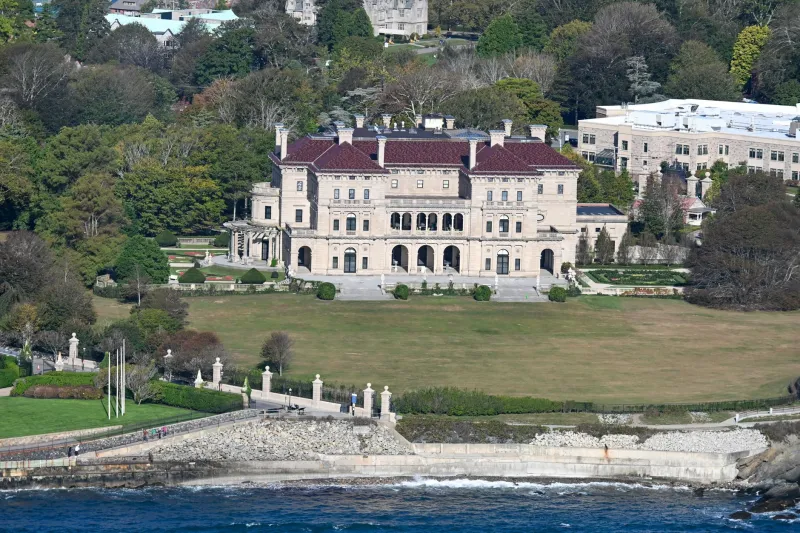
For buyers with the means to assemble such a team, the results are incomparable. A meticulously restored Gilded Age mansion retains a quality of material presence—the weight of its stone, the depth of its ornamental detail, the particular quality of light through its original windows—that no amount of new construction can approximate. This is not sentimentality. It is an honest accounting of what is lost when historic structures are demolished or compromised beyond recovery.
The Financial Architecture of Preservation
The cultural arguments for historic restoration are compelling on their own terms. The financial structure that has grown up around preservation, however, has made the economics increasingly persuasive as well—particularly for buyers whose financial sophistication extends to understanding the full range of instruments available to them.
The Federal Historic Tax Credit, which provides a 20 percent credit against the qualified rehabilitation expenditures on income-producing historic properties, represents one of the most significant incentives available to buyers engaged in serious restoration work. For properties that qualify—and the eligibility criteria reward genuine, standards-compliant restoration rather than superficial gestures—the credit can meaningfully offset the substantial costs that authentic preservation demands.
Conservation easements offer a complementary mechanism. By donating a preservation easement to a qualified land trust or preservation organization, an owner places permanent restrictions on the property's future alteration while potentially realizing significant tax benefits. The easement runs with the land, binding future owners as well—a fact that some buyers find appealing precisely because it guarantees the property's character in perpetuity.
State-level preservation incentives vary considerably but can be substantial. Virginia, New York, and Massachusetts, among others, have developed programs that layer meaningfully on top of federal benefits, making the financial case for restoration in those states particularly compelling.
Philanthropic Positioning and the Legacy Dimension
Beyond the direct financial instruments, the restoration of a significant historic property opens philanthropic and reputational dimensions that are increasingly valued by buyers for whom conventional markers of wealth have lost their differentiating power.
The buyer who rescues a deteriorating National Historic Landmark from neglect and restores it to a condition that exceeds its original specification is not simply acquiring real estate. They are performing an act of cultural stewardship that positions them within a tradition of American patronage stretching back to figures like John D. Rockefeller Jr., whose restoration of Colonial Williamsburg remains one of the most ambitious private preservation projects in the nation's history.
This positioning carries genuine social currency in the circles that matter most to buyers at this level. Museum boards, preservation societies, and architectural foundations regard serious restoration patrons with a respect that no amount of new construction can generate. The owner of a sensitively restored Frank Lloyd Wright house occupies a different category of cultural standing than the owner of a newly built estate, however impressive the latter may be.
For buyers who are also thinking about legacy—about what they will leave behind and how they will be remembered—this distinction is not trivial.
What the Market Is Recognizing
The broader real estate market has begun to register what preservation-minded buyers have understood for some time: that architecturally significant historic properties, when properly restored, hold their value with a tenacity that generic luxury properties frequently do not.
The reasoning is straightforward. A well-restored historic property is, by definition, irreplaceable. The land cannot be replicated. The craftsmanship embedded in the structure cannot be manufactured at any price. The architectural pedigree—whether that means the name of a significant architect, association with a historically important family, or simply the quality of construction that characterized a particular era—adds a layer of value that is immune to the supply dynamics that periodically deflate even prestigious new developments.
In markets where historic inventory is genuinely scarce—the Gold Coast of Long Island, the Back Bay of Boston, the antebellum districts of Charleston and Savannah—the premium commanded by well-maintained historic properties over comparable new construction has widened consistently over the past decade.
The Rarest Form of Distinction
Helmerstone has long observed that the most enduring luxury addresses are not simply locations. They are propositions—statements about what their owners value and how they understand their place in the longer arc of American culture and commerce.
In that context, the choice to acquire and restore a historically significant property may be the most complete statement available to today's most discerning buyers. It requires not only the financial capacity to undertake work of genuine complexity, but the patience, the knowledge, and the sense of responsibility to do it with integrity.
Those qualities have always been rarer than money. That is precisely what makes them, in the end, the most reliable signal of distinction.