The Eloquence of Disappearance: How America's Most Refined Buyers Are Building Homes the Landscape Absorbs
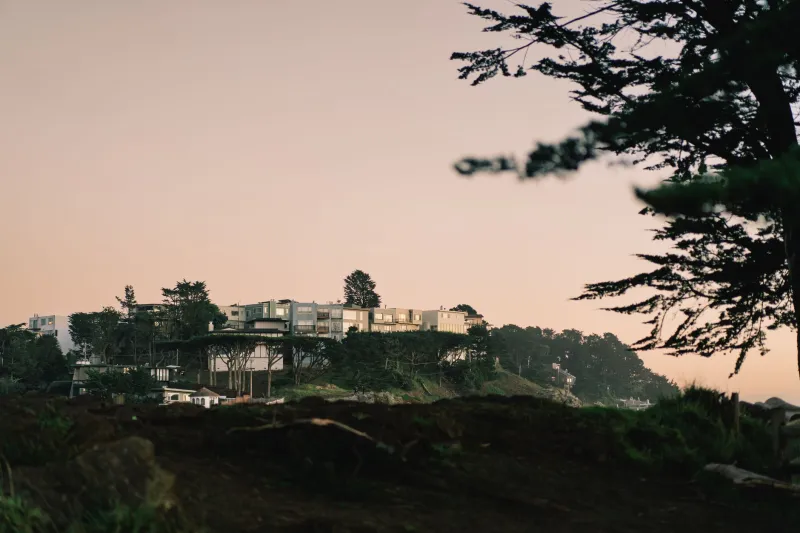
There is a particular kind of ambition that expresses itself through silence. In the most exclusive residential commissions currently underway across the American landscape—from the volcanic ridgelines of the Pacific Northwest to the tallgrass prairies of the Mountain West—a growing cohort of discerning buyers is choosing to build homes that, by every visible measure, are not quite there. These are not modest houses. They are, in many cases, among the most technically complex and financially significant private residences being constructed anywhere in the country. And yet their defining characteristic is the degree to which they refuse to be seen.
This is the architecture of discretion. And it is, by every meaningful measure, the new frontier of luxury.
The Trophy Era and Its Discontents
To understand why this movement has taken hold, it is worth briefly revisiting what it displaces. For much of the past three decades, the aspirational grammar of high-end residential architecture was written in the language of visibility. Grand facades. Commanding elevations. Materials chosen for their capacity to signal—marble that announced itself, glass that reflected the world back at itself, massing that insisted upon recognition from every angle of approach.
That tradition was not without its own coherence. It reflected a moment when newly consolidated wealth sought external validation, when the property itself served as a kind of credential. But among the most quietly influential segment of today's ultra-high-net-worth buyers—those who have long since moved beyond the need for architectural endorsement—that vocabulary has begun to feel not merely dated but philosophically inadequate.
"The most sophisticated clients I work with now are actively embarrassed by ostentation," notes one architect who has completed projects in Colorado, Montana, and coastal Maine for clients with combined net worths exceeding several billion dollars. "What they want is something that makes a stranger wonder whether anything is there at all. That is the brief."
Siting as the First Act of Design
For architects working within this philosophy, the process begins not with a floor plan but with a forensic study of the land itself. The discipline of strategic siting—placing a structure in precise relationship to topography, prevailing light, seasonal vegetation patterns, and sightline corridors—becomes the primary creative act. A home that disappears is, before anything else, a home that has been placed correctly.
In practice, this means commissioning extensive surveys that map not only the physical contours of a parcel but its visual exposure from every accessible vantage: neighboring roads, adjacent properties, aerial approaches, even the sight lines of passing watercraft where coastal sites are concerned. The goal is to identify the positions where a structure can occupy the land without interrupting it—tucking into a natural berm, sheltering behind an existing tree line, or descending into a depression in the terrain that renders it invisible from the surrounding plane.
Some of the most technically demanding examples currently in development involve what practitioners call "negative siting"—the deliberate excavation of the building's footprint into the earth itself, so that rooflines sit at or below grade when viewed from a distance. On properties in New Mexico and the high desert regions of Nevada, this approach allows estates of considerable square footage to exist in plain sight of public land while remaining effectively invisible to anyone not standing directly above them.
The Material Palette of Invisibility
Once siting has established the structural logic, material selection becomes the instrument of its completion. The palette favored by architects working in this idiom is drawn almost entirely from the site itself—or from materials that read, at a distance, as indistinguishable from the surrounding geology.
Rammed earth, weathered steel that oxidizes to the precise ochre of surrounding sandstone, rough-sawn timber left to silver in the local climate, and locally quarried stone applied in courses that echo the natural stratification of nearby outcroppings: these are the materials of the disappearing house. Glass, where it appears, is selected for minimal reflectivity and positioned to read as shadow rather than surface. Rooflines are planted with native sedums, grasses, and wildflowers that shift with the seasons, ensuring the structure's silhouette changes in concert with its surroundings rather than against them.
The effect, when executed with precision, is genuinely disorienting. Properties that contain tens of thousands of square feet of living space—with all the mechanical complexity, climate control, and structural engineering that entails—present themselves to the casual observer as nothing more than a slight variation in the texture of the hillside. The sophistication is entirely interior, which is precisely the point.
Restraint as the Highest Form of Confidence
What motivates a buyer to invest, in some cases, considerably more per square foot than a conventionally visible luxury home would require—in engineering, in site remediation, in specialized materials—in order to produce a result that no one will notice? The answer, when examined closely, reveals something significant about how the most selective segment of the American market now understands the relationship between wealth and expression.
"The clients who commission these projects have nothing left to prove," observes one landscape architect whose firm has worked on camouflage-sited estates in Wyoming and Vermont. "They're not building for the approval of people who drive past. They're building for themselves, for the landscape, and for the long view. That combination requires a kind of confidence that is genuinely rare."
This is luxury reconceived as an internal condition rather than an external performance. The home that disappears into its landscape is not humble in any conventional sense—it is, in fact, the product of extraordinary investment and intellectual ambition. But its ambition is directed inward, toward the quality of experience it creates for those within, and outward, toward the integrity of the land it inhabits. It makes no claim on the attention of passersby because it requires none.
The Environmental and Civic Dimensions
It would be incomplete to discuss this movement without acknowledging the genuine environmental logic it embodies. Homes designed to integrate with their terrain typically consume less energy, disturb fewer natural systems during construction, and impose a smaller long-term footprint on the ecosystems they occupy. The use of native plantings on rooflines and in surrounding grounds supports local biodiversity. The preference for locally sourced materials reduces embodied carbon and maintains the visual continuity of regional landscapes.
For buyers who are simultaneously stewards of significant land holdings—ranches, coastal preserves, forested estates—the camouflage home represents a coherent expression of values that extend well beyond aesthetics. It is architecture as land ethic, a built argument for the proposition that human habitation and ecological integrity need not be in opposition.
A New Standard Takes Shape
At Helmerstone, we have observed across multiple market cycles that the defining characteristics of truly enduring residential properties are rarely the ones that attract the most immediate attention. The estates that appreciate most reliably—in value, in cultural regard, and in the private satisfaction of their owners—tend to be those built with a long horizon in mind, with materials and philosophies that improve with time rather than date against it.
The disappearing house is, by that measure, among the most promising expressions of residential ambition currently visible in the American luxury market. It asks more of its architects, more of its builders, and more of its owners than the trophy property ever did. In return, it offers something that no amount of marble or glass can purchase: the quiet certainty of belonging, without announcement, to a place that will outlast the fashions of any particular moment.
That, in the end, is the address that distinction has always been seeking.