The Virtue of Stillness: Why America's Most Discerning Buyers Are Paying a Premium for Places That Resist Change
Conventional real estate wisdom has long rewarded the early mover—the buyer who identifies a neighborhood before its character is fully legible, who acquires ahead of the coffee shops and the boutique fitness studios and the inevitable headline declaring a district "the next great American neighborhood." For decades, this logic has shaped how wealth moves through the market: anticipate transformation, capture appreciation, repeat.
A significant and quietly influential segment of ultra-wealthy buyers has grown weary of this calculus entirely.
They are not contrarians for the sake of it. They are, in many respects, the most deliberate participants in the luxury market today—buyers who have completed the cycle of acquisition and novelty and arrived at something more considered. What they want now is not the place that is becoming something. They want the place that simply is.
The Allure of the Unchanging
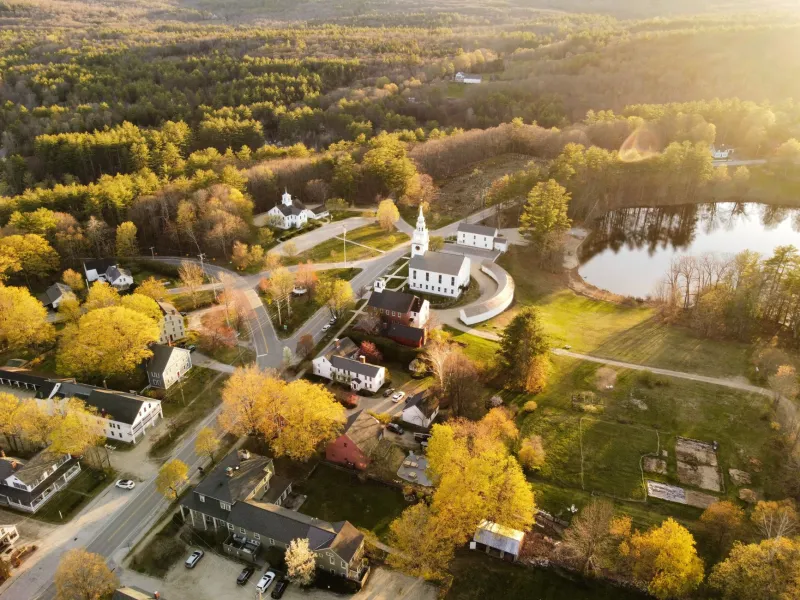
There is a category of American community that has resisted, whether by geography, governance, or sheer collective will, the forces that have homogenized so much of the country's built environment. These are towns where zoning boards take their charge as a form of stewardship rather than bureaucratic obligation. They are coastal villages where building height restrictions have held for generations, historic districts where the approval process for exterior alterations runs to months rather than weeks, and rural counties where the land itself—its topography, its agricultural character, its particular quality of light—makes large-scale redevelopment economically impractical.
For buyers accustomed to properties that express their owner's individuality, these places offer something increasingly scarce: an identity that precedes them and will outlast them. The community does not require the buyer to define it. It arrives fully formed, with its own grammar of architecture, its own social rhythms, its own relationship to the surrounding landscape.
This is not a small thing. In a culture that places extraordinary pressure on the individual to curate every visible dimension of their life, the relief of belonging to a place that already knows what it is can be profound.
What Slow Places Actually Offer
The properties that exist within these communities tend to share certain qualities that command attention from buyers who have seen a great deal of fine real estate. Construction methods and materials reflect regional traditions rather than the universal vocabulary of contemporary luxury. Proportions are governed by historical precedent. Gardens have had decades, sometimes generations, to mature into something that no amount of capital can accelerate.
There is also the matter of neighbors. Communities that resist change tend to attract and retain owners who share that disposition—people who chose the place for what it was rather than for what it might become. The result is a social fabric with unusual coherence and, frequently, unusual discretion. These are not neighborhoods that generate social media content or appear in trend-driven editorial coverage. Their very resistance to the mechanisms of modern visibility is part of what makes them valuable.
For buyers whose primary concern is the quality of daily experience rather than the optics of ownership, this combination—architectural integrity, landscape maturity, social consistency—represents a form of luxury that the emerging-market playbook cannot replicate.
The Contradiction with Conventional Appreciation Logic
It would be intellectually dishonest to present this preference without acknowledging its tension with standard investment thinking. Properties in stable, slow-moving communities do not typically generate the dramatic appreciation curves associated with transitional neighborhoods. By definition, a place that resists change also resists the kind of speculative momentum that drives headline returns.
And yet the buyers making these acquisitions are rarely operating under the assumption that real estate functions primarily as a financial instrument. Many have reached a stage of wealth at which the marginal difference between a strong return and a moderate one is far less meaningful than the quality of the environment in which they spend their time. The question shifts from "what will this be worth in ten years" to "will this still be worth living in in ten years."
In that reframing, the slow place often wins. The neighborhood that has resisted homogenization for the past four decades is, by reasonable inference, likely to continue doing so. Its very resistance is evidence of structural durability—of zoning frameworks, community institutions, and ownership cultures that have proven their staying power. That is its own form of security, and for buyers who have grown skeptical of markets that reward transformation over substance, it carries considerable weight.
Regional Expressions of Permanence
Across the United States, the communities drawing this kind of attention vary considerably in character but share a common thread of deliberate self-preservation. Certain New England towns—particularly those along the Connecticut shoreline and the Massachusetts North Shore—have maintained their architectural and social character with remarkable consistency, supported by robust historic preservation frameworks and ownership communities deeply invested in continuity.
In the mid-Atlantic, select areas of the Virginia hunt country and the Eastern Shore of Maryland occupy a similar position: landscapes shaped by agricultural and equestrian tradition that have proven largely indifferent to the development pressures reshaping neighboring regions. The properties here are often substantial, the land generous, and the pace of life calibrated to something other than market cycles.
In the West, the dynamic is different but the underlying logic holds. Certain mountain communities and coastal enclaves have used a combination of geographic constraint and local governance to preserve characters that might otherwise have been absorbed into the broader machinery of resort development. The result is places that feel, against considerable odds, genuinely themselves.
The Deeper Appetite
What unites buyers drawn to these places is something that transcends any particular property type or regional preference. It is, at its core, a hunger for authenticity—not the performed authenticity of a carefully branded new development, but the kind that accrues through time and resistance and the accumulated choices of generations of owners who cared about the same things.
This is a sophisticated position, and one that requires a certain maturity of perspective to reach. It means accepting that the property you acquire will not be a canvas for reinvention. It means committing to a community on its own terms. It means understanding that the value of a place is sometimes best measured not by what it is becoming, but by what it has consistently refused to become.
For a growing number of America's most discerning buyers, that refusal is precisely the point. In a market defined by transformation, the rarest commodity may be a place that has found no reason to change—and the wisdom to recognize it as such.