What the Land Remembers: Why America's Most Discerning Buyers Are Choosing Terrain Over Prestige
For generations, the calculus of luxury real estate followed a familiar logic: acquire the most celebrated address, in the most recognized enclave, within the most legible market. The zip code was the credential. The neighbors were the endorsement. The value was, in large measure, borrowed from the surrounding consensus.
That logic is quietly fracturing.
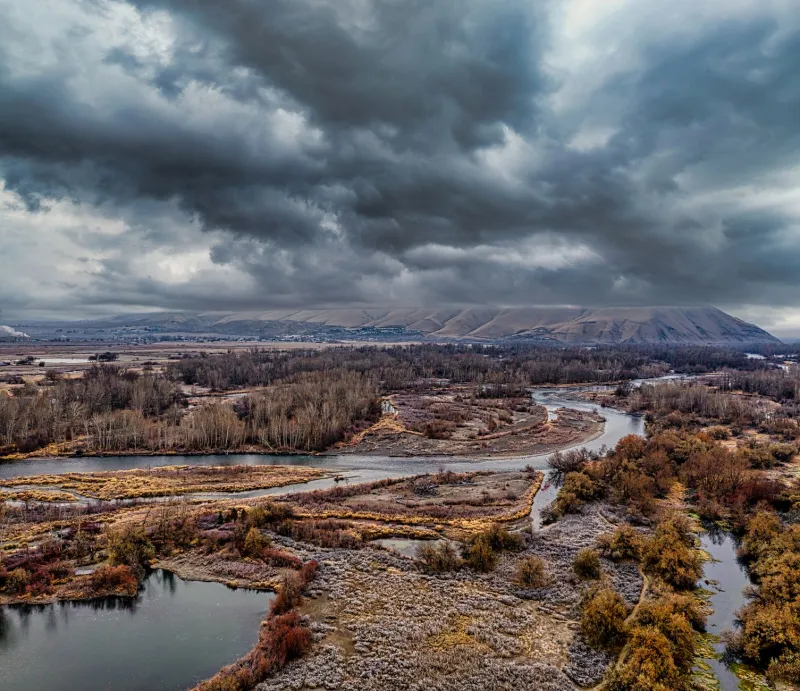
Across the American landscape—from the volcanic plateaus of the Pacific Northwest to the ancient limestone ridges of the Texas Hill Country, from the tidal marshes of coastal Georgia to the high-altitude meadows of the Colorado Rockies—a distinct class of buyer is making decisions that confound conventional market analysis. They are passing over trophy addresses in favor of properties that carry no particular social cachet, acquiring land that would register as unremarkable by traditional metrics, and paying premiums that the market cannot fully explain.
What they are purchasing, in essence, is meaning. And they are finding it not in the address, but in the earth itself.
The Limits of Location
The concept of location as the supreme determinant of real estate value rests on a social foundation: a property is desirable because others agree it is desirable. Prestige, in this framework, is a collective agreement, maintained by proximity to certain amenities, historical associations, and the presence of similarly credentialed neighbors.
For buyers whose own standing requires no external reinforcement, this framework offers diminishing returns. When one has already inhabited the most celebrated addresses—the Greenwich estates, the Palm Beach compounds, the Aspen retreats—the marginal distinction of yet another prestigious zip code becomes negligible. The address no longer confers anything the buyer does not already possess.
What emerges in its place is a more exacting and deeply personal set of criteria. Buyers begin to ask not where a property ranks, but what it is. Not what the market says it is worth, but what it holds that cannot be replicated elsewhere on earth.
The Language of Terroir
The concept of terroir—borrowed from viticulture and its recognition that the specific combination of soil, slope, microclimate, and geological history imparts irreproducible character to what grows from a given place—has migrated quietly into the vocabulary of serious land acquisition.
A property's terroir, in this expanded sense, encompasses everything the land has accumulated over millennia: the particular mineral composition of its bedrock, the hydrology of its watershed, the ecological communities that have established themselves across its surface, the record of human and natural history written into its topography.
Sophisticated buyers are commissioning geological surveys not as due diligence exercises but as acts of discovery. They are engaging hydrologists to understand the underground aquifer systems that sustain a property's springs and streams. They are consulting ecologists to identify the rare plant communities or migratory corridors that make a particular parcel singular. In each case, the inquiry is the same: what does this land hold that no other land holds in quite this way?
The answers to those questions are increasingly driving acquisition decisions of significant magnitude.
Watershed as Asset
Among the most consequential shifts in this emerging sensibility is the recognition of water—not as a utility, but as a defining character of land.
Properties centered on functioning watershed systems—those that originate, filter, and sustain their own water supply through natural hydrology—have acquired a distinction that transcends acreage or architectural merit. A ranch in Montana that encompasses the headwaters of a cold-water trout stream, a New England estate whose spring-fed pond has maintained consistent water quality for centuries, a Pacific Coast holding whose creek system supports endangered salmon runs: each of these represents a form of natural singularity that cannot be engineered or approximated.
In an era of increasing water scarcity and climate volatility, this singularity carries both practical and philosophical weight. The land that holds its own water, that has sustained its own ecological systems through drought and flood and seasonal variation, demonstrates a resilience that manufactured environments cannot claim. For buyers thinking in generational terms—those acquiring land they intend to steward across decades and pass to heirs—this resilience is not incidental. It is central.
Geological Character and the Irreplaceable
Beyond hydrology, the geological formations that define a property's physical character have emerged as meaningful differentiators for buyers attuned to the deeper language of land.
A property anchored by a dramatic sandstone escarpment carries a visual and experiential signature that is geologically fixed—the product of processes operating across timescales that dwarf human history. The limestone karst topography of certain Kentucky and Tennessee holdings, with its caves, sinkholes, and underground streams, creates a subterranean dimension of ownership that is wholly unlike any other landscape. The basalt formations of the Columbia River Plateau, the granite domes of the Sierra Nevada foothills, the ancient coral formations that underlie certain Florida properties: each imposes on a parcel a character so specific and so durable that no adjacent property can truly replicate it.
Buyers who recognize this specificity are, in effect, acquiring geological rarity. They are purchasing a piece of the earth's autobiography—a passage that will not be revised.
Historical Terroir and the Weight of Time
The human history inscribed in a landscape constitutes its own form of irreplaceable character. Properties that have served as the sites of significant historical events, that have been continuously inhabited or cultivated across centuries, or that bear the physical traces of indigenous use and settlement carry a temporal density that newer parcels cannot possess.
This historical terroir is not merely sentimental. It manifests in the mature tree canopy shaped by generations of deliberate planting, in the stone walls and earthworks that record earlier patterns of land use, in the soil profiles altered by centuries of agricultural practice. The land, in these cases, is a palimpsest—each era of human engagement leaving its impression beneath the next.
For buyers drawn to properties of this character, the acquisition is an entry into an ongoing story rather than the initiation of a new one. Stewardship, in this context, is not a burden but a privilege: the opportunity to add one's own chapter to a narrative already rich with time.
Distinction Redefined
What unites these various expressions of land-centered acquisition is a fundamental reorientation of what distinction means in the context of real estate. For the buyers driving this shift, distinction is no longer a function of external validation—the celebrated address, the recognized enclave, the market consensus. It is a function of internal resonance: the degree to which a property's singular character aligns with the buyer's own sensibility, values, and vision for the land's future.
This is, in many respects, a more demanding standard than prestige. A prestigious address requires only the ability to purchase it. A property chosen for its geological singularity, its watershed integrity, or its historical depth requires the knowledge to recognize those qualities and the intention to honor them.
At Helmerstone, we observe this shift not as a departure from the principles of distinguished property ownership, but as their logical culmination. The most discerning owners have always understood that genuine distinction cannot be borrowed from a zip code. It must be found—or, in the rarest cases, recognized—in the land itself.