Architects of Aspiration: Five Visionaries Whose Names Are Synonymous With American Luxury Residential Design
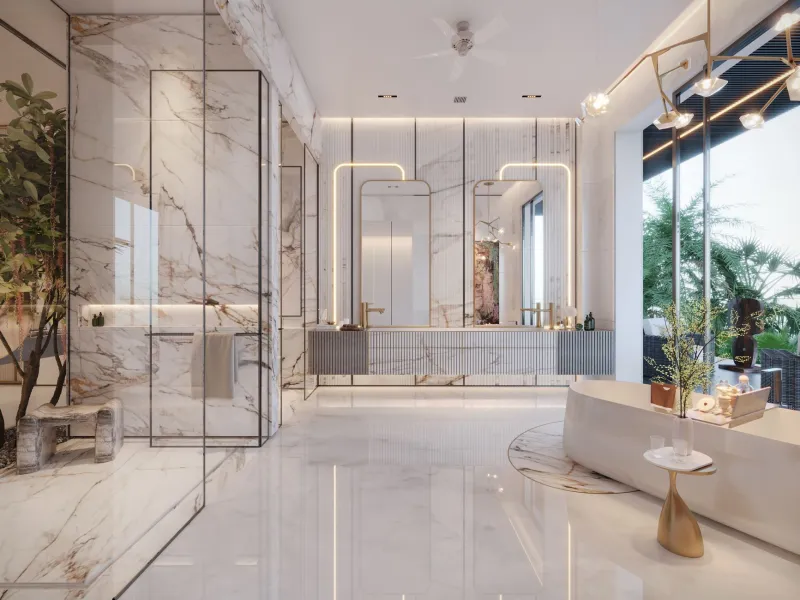
In the rarefied world of bespoke luxury residential design, a handful of architects and designers have transcended their profession to become something closer to cultural institutions. Their names appear on waiting lists measured in years, their commissions command price points that redefine the possible, and their completed works do not merely house their occupants—they articulate an entire philosophy of living.
For the discerning buyer seeking not simply a residence but a statement of enduring personal distinction, understanding who these individuals are—and what separates their work from the merely exceptional—is essential due diligence. Helmerstone profiles five such figures whose influence on contemporary American luxury residential design is both profound and ongoing.
1. The Poet of Material: Olson Kundig and the Art of Honest Architecture
Seattle-based Olson Kundig has, over the course of more than five decades, developed a design language so thoroughly its own that the firm's work is immediately recognizable to any serious student of contemporary American architecture. Founded by Tom Kundig—a Pritzker Prize-adjacent figure who has received the American Institute of Architects' highest individual honor—the practice has built its reputation on a philosophy that might be described as muscular restraint.
Kundig's residential projects are distinguished by their unflinching engagement with raw materials: weathered steel, unfinished concrete, reclaimed timber, and locally sourced stone appear not as decorative choices but as structural and philosophical commitments. The firm's celebrated "gizmo" elements—large-scale mechanical devices, hand-operated pivoting walls, counterweighted roof panels—introduce a sense of human agency into the architecture itself, inviting occupants to participate in the daily choreography of their home.
For clients of significant means drawn to the American West and Pacific Northwest, an Olson Kundig commission represents an investment in architecture that ages with intention. Projects such as the iconic Chicken Point Cabin in northern Idaho and the Studhorse residence in Washington State have become touchstones of a design movement that prizes authenticity over ostentation—a distinction that resonates powerfully with a segment of the ultra-wealthy for whom understatement is the ultimate luxury.
Signature elements: Exposed structural systems, hand-operated mechanical features, material honesty, deep site integration. Notable markets: Pacific Northwest, Mountain West, rural retreats.
2. The Classicist Reimagined: Peter Pennoyer Architects and the Enduring Grammar of Elegance
In an era that has often privileged novelty over continuity, Peter Pennoyer Architects occupies a singular and quietly influential position in American luxury residential design. The New York-based firm draws deeply from the classical tradition—from Beaux-Arts formalism to the Georgian and Federal vernaculars that define the finest pre-war American domestic architecture—while producing work that is unmistakably and rigorously contemporary in its execution.
Pennoyer's clients tend to be individuals who have concluded that the architectural fashions of any given decade are less durable than the principles that have governed elegant building for centuries. The firm's commissions—spanning Park Avenue apartments of museum-worthy refinement, country houses in Connecticut and the Hudson Valley, and resort properties of considerable grandeur—share a commitment to proportion, symmetry, and the careful deployment of ornament that distinguishes scholarship from pastiche.
For buyers whose aesthetic sensibility runs toward the historical and whose investment horizon extends across generations, a Pennoyer commission offers something that purely contemporary architecture often cannot: the confidence that a building will be considered beautiful not merely today, but fifty years hence. In an era of accelerating architectural trends, that is a form of resilience with genuine financial implications.
Signature elements: Classical proportions, bespoke millwork, formal room sequence, historically informed detailing. Notable markets: New York metropolitan area, New England, established resort communities.
3. The California Modernist: SPF:architects and the Seamless Indoor-Outdoor Ideal
No discussion of contemporary American luxury residential design would be complete without engagement with the Southern California tradition of indoor-outdoor living—and few firms have advanced that tradition with greater sophistication than Los Angeles-based SPF:architects, led by Zoltan Pali. The firm's residential work has helped define a vision of the California luxury home that is simultaneously technically rigorous and sensuously livable.
SPF:architects approaches the relationship between interior space and landscape not as a design feature but as an organizing architectural principle. Retractable glass walls of extraordinary scale, carefully considered threshold conditions, and the deliberate choreography of views through and beyond a structure characterize projects that feel as though they have been grown from their sites rather than placed upon them.
The firm's work appeals particularly to clients in the entertainment, technology, and creative industries—individuals whose professional lives demand spaces capable of accommodating both intimate personal retreat and large-scale social engagement. The ability to design a home that functions with equal grace as a private sanctuary and a venue for curated gatherings of significant scale is a rare capability, and one that commands a corresponding premium in the Los Angeles market.
Signature elements: Large-span retractable glazing, site-responsive massing, integrated landscape design, material warmth within a modernist framework. Notable markets: Los Angeles, Malibu, coastal California, Hawaii.
4. The Technologist: Bjarke Ingels Group Residential and the Architecture of Ideas
While the Danish-founded Bjarke Ingels Group—universally known as BIG—operates across scales from urban master planning to product design, the firm's residential work in the American market has attracted significant attention from a cohort of ultra-high-net-worth buyers whose appetite for intellectual distinction in their built environment is as pronounced as their appetite for material quality.
BIG's residential commissions are, in the most literal sense, architectural propositions. Each project begins with a conceptual idea of genuine rigor—a geometric operation, a programmatic inversion, a relationship between form and landscape that has not been explored in quite that way before—and builds outward from that intellectual core. The results are homes that function as three-dimensional arguments about how life at the highest level might be lived.
For clients who have achieved sufficient success to feel that the conventional markers of luxury no longer sufficiently distinguish their environment, a BIG residential commission offers something more elusive: the experience of living inside a genuinely original idea. The firm's ability to integrate advanced sustainable technologies—green roofs, passive ventilation systems, integrated renewable energy infrastructure—within formally ambitious architecture has made it particularly attractive to environmentally conscious buyers who refuse to accept any compromise between ecological responsibility and design excellence.
Signature elements: Conceptual rigor, formal innovation, integrated sustainability, programmatic inventiveness. Notable markets: New York, Miami, select West Coast markets, resort communities.
5. The Interior Architect: AD100 Stalwart Peter Marino and the Synthesis of Art and Habitation
To speak of Peter Marino in purely architectural terms is to understate the nature of his practice. The New York-based designer—a perennial presence on Architectural Digest's AD100 list and one of the most commercially successful luxury practitioners in the world—operates at the intersection of architecture, interior design, and art curation in a manner that has effectively defined a new category of residential service for the ultra-wealthy.
Marino's residential commissions are distinguished above all by their relationship to art. His clients are invariably significant collectors, and his design process begins not with spatial planning but with a comprehensive engagement with the collection that will inhabit the space. The result is environments in which architecture and art exist in a state of mutual amplification—where the proportions of a room have been calibrated to the scale of a specific painting, and the material palette of a corridor has been selected to enhance the reading of a particular sculpture.
The practical implication for buyers is that a Marino commission is not merely the acquisition of a beautiful home. It is the engagement of a creative intelligence capable of synthesizing an entire way of life—encompassing art, hospitality, material culture, and architectural experience—into a single, coherent residential environment. At the price points his practice commands, that synthesis represents one of the most significant value propositions available in the contemporary luxury market.
Signature elements: Art-integrated spatial planning, bespoke material specifications, curatorial sensibility, hospitality-grade experiential design. Notable markets: New York, Palm Beach, Hamptons, international resort properties.
A Note on Selecting Your Architect
For clients of Helmerstone embarking upon a significant residential commission, the selection of an architectural partner is among the most consequential decisions in the entire development process. The five practices profiled here represent distinct philosophical positions and aesthetic sensibilities—and the right choice will depend not upon which name carries the greatest market cachet, but upon which vision most authentically reflects the life you intend to inhabit.
The finest luxury architecture does not impose itself upon its occupants. It reveals, over time and through daily experience, an ever-deepening understanding of how thoughtfully designed space can elevate the quality of human life. That is the standard against which every commission at this level should be measured—and it is the standard that each of these remarkable practitioners, in their own distinctive way, consistently meets.